Work · 2026
An agent team that plans marketing campaigns and executes deliverables
Overview
Our marketing team is two people, and the campaigns we needed to run required dozens of coordinated assets across email, ads, blog, and social. I built a two-agent system where a Strategist collaborates with me on the plan and a Manager delegates the actual writing to specialized agents, so humans are in the loop for strategizing, reviewing deliverables, and setting up the campaign.
34
Campaign assets produced (emails, sequences, ads, blogs, posts)
4 days
From planning through completed, staged deliverables
The challenge
One person can set a campaign's strategy, but one person can't produce everything downstream of it.
Our campaigns aren't small. A single one needs a mix of assets planned across multiple weeks. Our old process for executing campaigns ran on manual handoffs between stakeholders, each managing their deliverables and going through multiple review gates.
That system was built for a bigger team than the one we have. With a two-person marketing team and campaigns that dense, running it the old way meant either the campaign shrank to fit what we could hand-write, or it shipped slow, or didn't ship at all. None of those were acceptable.
As the person owning campaign execution, my part is supposed to be the strategy: the vision, the messaging, the call on what this campaign is actually trying to do. Everything after that, the emails, the sequences, the ads, the posts, needed to come from somewhere else, and it needed to come fast.
The approach
Split the work at the one place a human still has to make a judgment call.
The strategy and the execution needed to be two different jobs, done by two different agents, with a real approval gate between them.
- A Strategist agent has to sit with me through the actual planning work, the interview, the structure, the messaging, the theming, the way a strategist would, and produce a plan, not copy.
- That plan has to be complete enough that a separate agent could execute every asset from it without coming back to ask what I meant.
- A Manager agent then reads that plan and delegates each asset to a specialized writing agent, running batches in parallel instead of one at a time.
- Every proof point used across the campaign has to carry a clearance status, enforced the same way in every asset, so nothing external gets a claim it shouldn't.
- Nothing goes out without me reviewing it. Not the plan, not the drafts, not the finished batch.
What I did
A Strategist that plans and a Manager that executes, with the plan itself as the handoff.
The Strategist plans, and never writes final copy
It works in five phases. It interviews me on the campaign's goal, motion, timing, audience, and channels, then proposes a structure: the audience list, the asset list, the rough timeline. I review and lock that before anything else happens. From there I provide the messaging, a hero narrative, key proof points with clearance status, competitive positioning, per-audience angles, then the Strategist and I walk through every single asset one at a time, brainstorming direction and structure into an asset guide. The plan lands as a Notion page, following a canonical reference plan every future campaign plan is built against.
The Manager reads that plan and runs execution
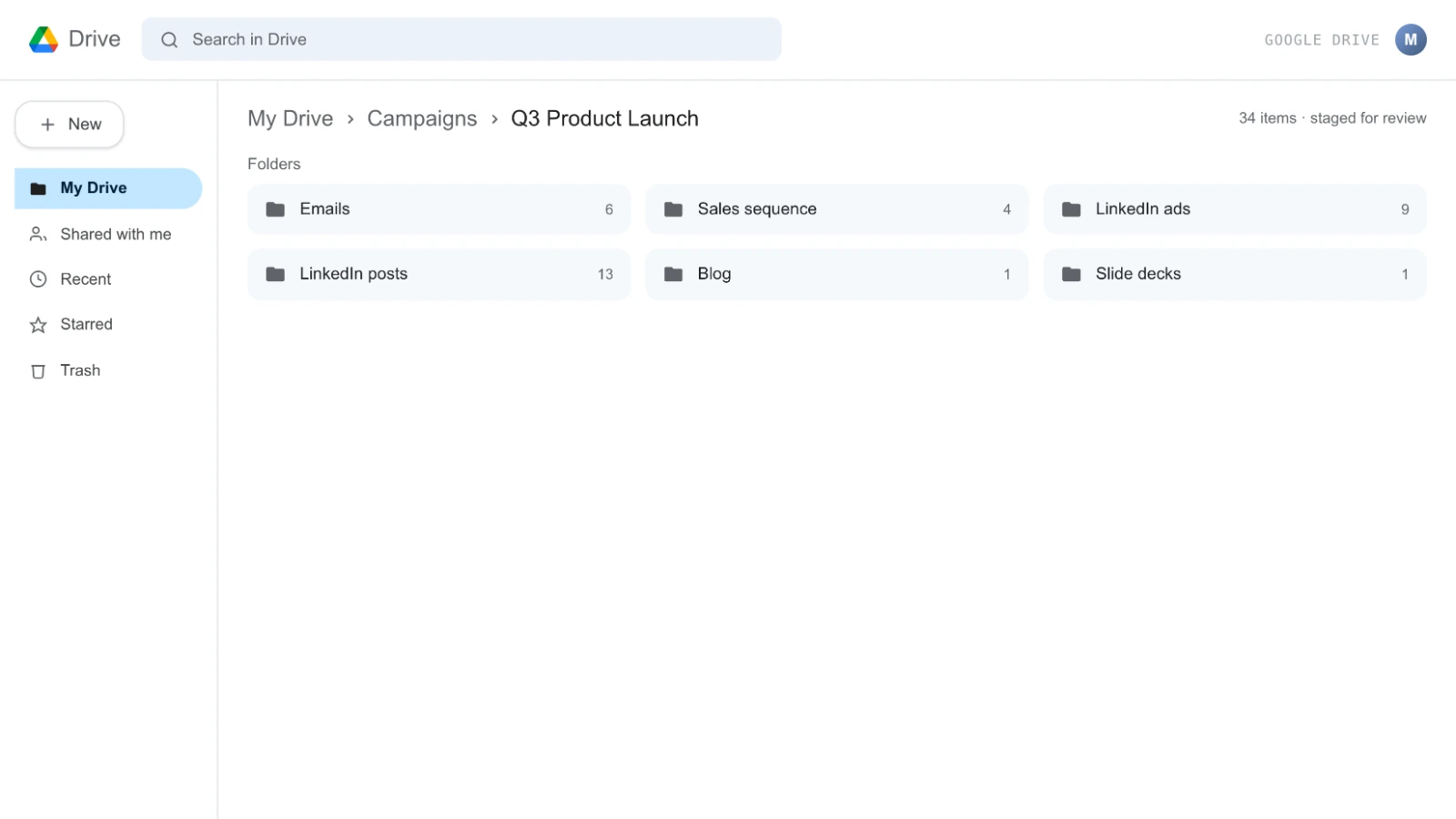
I hand it the Notion plan URL. It sets up a local folder, a Drive folder structure, and a deliverables tracker in Sheets, then delegates the asset guides out to a shared pool of writing agents in parallel batches of three or four, each one getting its asset guide plus whatever context it needs. Every finished asset lands in Drive as a native Google Doc, one doc per asset group: the blog, LinkedIn posts per account, all the email copy, each outbound sequence, ad copy, slide decks as native Slides. After each batch, I review in Drive and approve, request revisions, or skip.
Three checkpoints, never fewer
I approve the structure before messaging starts, I approve the full plan before execution starts, and I review every batch of deliverables in Drive before the next batch runs. Nothing gets published or sent by the system itself. It writes copy. It doesn't distribute it, doesn't touch paid media, and doesn't send a single email.
The results
The first campaign run produced a full campaign plan and 34 assets in four days.
Running my first campaign, the agent team produced 34 finished assets across marketing emails, a sales sequence, LinkedIn ads, a blog post, and LinkedIn posts. From the start of planning through completed, staged deliverables, including getting every asset ready to go live, the whole thing took four days.
What that number actually means is that the ceiling on a campaign stopped being how much two people could physically write and started being how good the strategy and narrative behind it is.